


King Arthur In Legend And History
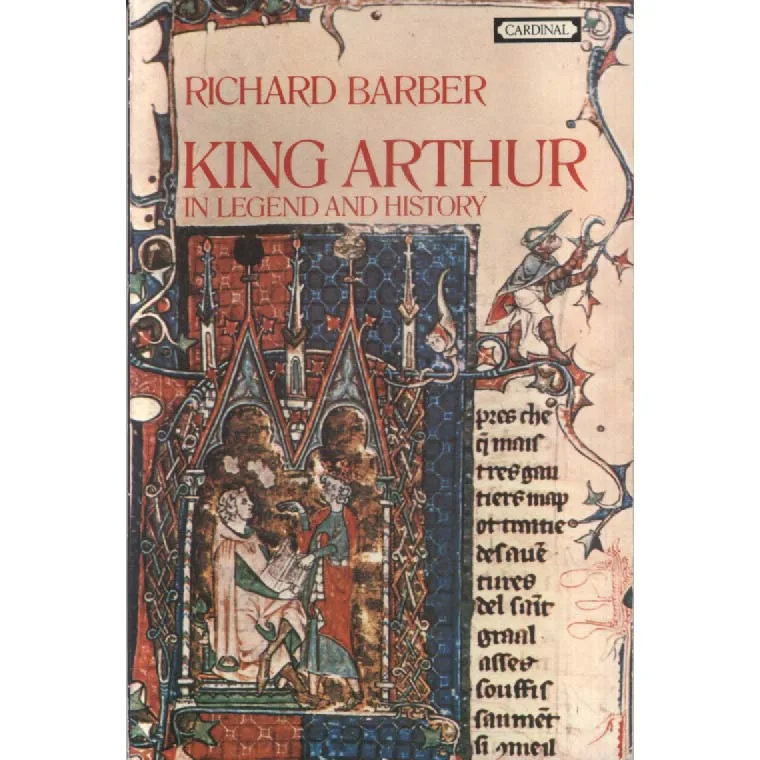
Publisher: Cardinal
Format: Paperback
ISBN: 0351152695
King Arthur in Legend and History (1973) by Richard Barber
Cardinal | ISBN: 0351152695 | Condition: Good
There are kings, there are legendary kings, and then there is King Arthur, a gentleman who may or may not have existed, whose kingdom cannot be located with any particular confidence, whose most famous sword was allegedly acquired through a thoroughly unconventional distribution system, and whose principal achievement has been to remain one of Britain’s most celebrated historical personalities despite the considerable inconvenience of there being very little reliable evidence that he was actually there. In King Arthur in Legend and History, distinguished medieval historian Richard Barber sets out to examine the extraordinary story of Britain’s most elusive monarch, separating centuries of romantic invention from the tantalising fragments of history that may have inspired the legend.
King Arthur occupies a remarkable position in the national imagination. He is simultaneously a warrior, king, Christian hero, romantic figure, defender of Britain and proprietor of the world’s most famous round table. His adventures have inspired poets, chroniclers, novelists, artists, filmmakers and generations of schoolchildren who have understandably concluded that medieval history would have been considerably more entertaining if it had involved fewer agricultural reforms and more enchanted swords.
Yet the question of whether Arthur actually existed has proved surprisingly difficult to answer. For a man supposedly responsible for uniting Britain, defeating invading armies and establishing a magnificent royal court, he left remarkably little in the way of contemporary documentation. No reliable royal correspondence, no surviving administrative records, no conveniently inscribed tombstone and certainly no entry in the sixth-century equivalent of Who’s Who.
This is a serious difficulty for historians, who generally prefer their kings to have left behind something more substantial than a collection of stories written several centuries after their supposed deaths.
Richard Barber approaches the subject with the instincts of a scholar rather than those of a gentleman determined to discover Camelot beneath the nearest picturesque hill. He examines the development of the Arthurian tradition, exploring the historical sources, literary transformations and cultural influences that gradually turned an obscure figure associated with Britain’s early medieval past into one of the most elaborate legends in European literature.
The historical background is fascinating in its own right. Following the end of Roman rule in Britain during the early fifth century, the country entered a period of political upheaval, migration, warfare and fragmented authority. The surviving written evidence is limited, often ambiguous and occasionally produced by individuals whose understanding of impartial historical reporting would not have satisfied the editorial standards of a moderately respectable local newspaper.
Against this troubled background emerged traditions concerning a great British warrior who resisted the advancing Anglo-Saxons. The earliest references associated with Arthur are fragmentary and open to interpretation, leaving historians with the challenging task of determining whether they preserve the memory of a real military leader, reflect several historical personalities combined into one, or represent the gradual development of a heroic figure who belonged primarily to folklore.
Naturally, this uncertainty has done absolutely nothing to discourage people from developing extremely confident theories about his identity.
Over the centuries, Arthur has been claimed by numerous locations, linked to various archaeological sites and enthusiastically associated with landscapes ranging from Cornwall and Wales to Scotland and northern England. Almost anywhere possessing a sufficiently ancient ruin, a mysterious hill or an unusually shaped rock seems capable of producing a respectable Arthurian connection, particularly if the local tourist industry considers the association commercially promising.
The legend’s literary development is equally remarkable. Early Welsh traditions and medieval historical writings gradually gave way to increasingly elaborate accounts of Arthur’s reign, culminating in the grand romances familiar to later generations. Geoffrey of Monmouth played a particularly important role in transforming Arthur into a mighty ruler of international significance, producing a narrative that was enormously influential despite its somewhat adventurous relationship with verifiable historical fact.
Geoffrey’s twelfth-century account helped establish a version of Arthur whose achievements extended far beyond the defence of post-Roman Britain. Here was a magnificent king, surrounded by heroic companions and engaged in exploits on an extraordinary scale. The result was an enormously successful contribution to medieval storytelling, demonstrating that historical writing could become considerably more popular when supplemented by impressive battles, dramatic personalities and events for which nobody was likely to demand documentary evidence.
Subsequent writers enthusiastically expanded the material. French romance authors introduced new adventures, characters and complications, enriching the Arthurian world with courtly love, chivalric ideals and the increasingly troublesome personal relationships of the knights. The stories developed into an elaborate imaginative universe in which noble warriors travelled across mysterious landscapes, encountered supernatural challenges and somehow found time to pursue romantic entanglements that would eventually threaten the stability of the entire kingdom.
The Knights of the Round Table became central to this tradition, providing Arthur with a fellowship of heroic companions supposedly united by courage, honour and mutual loyalty. The Round Table itself was a splendid idea, eliminating the difficulty of deciding who should occupy the most important position at a royal gathering. Unfortunately, the arrangement did little to prevent jealousy, rivalry, adultery or the occasional outbreak of spectacularly destructive family disagreement.
Indeed, Camelot appears to have been one of the most administratively challenging royal households in literary history. Its occupants were expected to uphold the highest standards of knightly virtue while repeatedly demonstrating an extraordinary ability to behave in ways almost guaranteed to undermine the entire enterprise.
Sir Lancelot, for example, was celebrated as one of the greatest knights in Christendom, which made his romantic involvement with Queen Guinevere particularly inconvenient. Sir Gawain possessed his own complicated collection of virtues and weaknesses, while the various quests undertaken by Arthur’s companions frequently involved leaving the kingdom to deal with its problems without them.
The pursuit of the Holy Grail added another dimension to the legend, transforming the adventures of Arthur’s knights into a mixture of spiritual allegory, religious symbolism and extraordinary medieval fantasy. The Grail itself became one of the most enduring mysteries in European literature, inspiring centuries of interpretation and speculation, along with an impressive number of modern novels in which obscure religious artefacts inevitably attract the attention of sinister organisations.
Then there is Merlin, perhaps the most famous magician in British literary tradition, whose remarkable powers apparently did not extend to ensuring that the people he advised refrained from making catastrophically foolish decisions. His prophecies, enchantments and mysterious origins became essential ingredients of the Arthurian world, helping transform what may originally have been traditions about a military leader into a sprawling collection of supernatural adventures.
Excalibur, meanwhile, must rank among the most celebrated items of military equipment in literary history. Depending upon the version of the story, Arthur’s famous sword is associated with a stone, a mysterious lake or a combination of traditions that later storytellers found convenient to rearrange. The resulting mythology is magnificent, even if it raises certain practical questions about the wisdom of accepting weapons from unexplained aquatic sources.
Barber’s subject is therefore not simply the question of whether a particular man called Arthur lived during the early Middle Ages. It is the much larger question of how legends develop, change and acquire meanings that reflect the interests of successive generations.
The Arthur of early British tradition is not quite the Arthur of Geoffrey of Monmouth, and neither is identical to the knightly monarch of medieval French romances or the tragic hero of Sir Thomas Malory’s Le Morte d’Arthur. Each version belongs partly to its own age, revealing the political ambitions, literary tastes and moral expectations of the people responsible for telling the story.
This is one of the most fascinating aspects of Arthurian history. The legend has repeatedly adapted itself to new circumstances, serving as a source of national identity, dynastic legitimacy, religious symbolism, romantic entertainment and moral instruction. Arthur has been whatever successive generations most needed him to be, which is an exceptionally demanding role for somebody whose historical existence remains uncertain.
Medieval rulers were particularly enthusiastic about associating themselves with Arthur, since an ancient heroic king represented a useful source of political prestige. Claims of descent, possession of Arthurian relics or connections with supposed royal sites could provide valuable propaganda, especially in periods when political authority depended partly upon convincing people that one’s ancestors had been unusually impressive.
The discovery of a supposed Arthurian tomb at Glastonbury Abbey in the late twelfth century was especially convenient, offering an apparent solution to the mystery of the king’s resting place. Unfortunately, the circumstances surrounding such discoveries invite precisely the sort of sceptical examination that makes historical research so entertaining. Medieval religious institutions were not entirely unfamiliar with the commercial and devotional advantages of possessing celebrated relics, particularly when those relics encouraged visitors to arrive carrying donations.
There is also the splendid geographical confusion surrounding Camelot. The legendary court has been associated with various locations, but no universally accepted historical site exists. This has allowed numerous places to maintain an enthusiastic claim upon the distinction, sometimes supported by archaeology, sometimes by medieval tradition and occasionally by the powerful argument that a particular hill looks exactly like the sort of place where King Arthur ought to have lived.
Tintagel in Cornwall, Glastonbury in Somerset and other celebrated Arthurian locations have become inseparable from the legend in the popular imagination. Their landscapes offer atmosphere, ancient remains and romantic associations that help sustain the appeal of the stories, even when the historical evidence is more complicated than the souvenir shops might suggest.
And perhaps that is part of the enduring charm of Arthur. The uncertainty allows the imagination enormous freedom. A firmly documented historical king is limited by dates, places, political decisions and the unfortunate tendency of surviving records to reveal embarrassing personal details. Arthur, by contrast, can remain an idealised symbol of courage, honour and lost greatness, conveniently free from the necessity of explaining his taxation policies or defending the performance of his government.
Richard Barber’s examination of the relationship between history and legend offers an especially rewarding perspective on this extraordinary cultural phenomenon. Rather than simply dismissing the stories as fiction or accepting them as historical truth, he explores how they emerged, what they reveal about the periods in which they developed and why they have retained their power over so many centuries.
It is a much more interesting exercise than merely attempting to establish whether Arthur owned a particular castle or participated in a specific battle. The evolution of the legend reveals an enormous amount about medieval culture, political thought, religious beliefs and the ways in which societies construct heroic versions of their own past.
Published in this Cardinal edition in 1973, King Arthur in Legend and History belongs to a period when public interest in medieval history, archaeology and the Arthurian tradition was particularly lively. It offers the opportunity to encounter the subject through the work of a serious historian who understands both the appeal of the legend and the importance of distinguishing historical evidence from imaginative tradition.
For readers whose knowledge of Arthur comes chiefly from films, television programmes and illustrated tales of knights in shining armour, the book provides a valuable introduction to the much more complicated literary and historical background. It reveals that the familiar Arthurian world was not created in a single moment, but developed gradually through centuries of storytelling, reinterpretation and occasionally spectacular invention.
There is something wonderfully ironic about the persistence of Arthurian mythology in an age supposedly devoted to scientific reasoning and historical accuracy. Modern society possesses advanced archaeological techniques, sophisticated methods of textual analysis and unprecedented access to historical information, yet the possibility of discovering Arthur’s true identity continues to attract speculation with almost medieval enthusiasm.
Every generation seems capable of producing another theory, another proposed location and another confident announcement that the mystery has finally been solved. Historians, meanwhile, continue examining the evidence with appropriate caution, thereby demonstrating the unfortunate professional disadvantage of being required to distinguish what can be proved from what would make a splendid television documentary.
The Arthurian legend also remains an extraordinarily rich source of literature and entertainment. Modern fantasy fiction owes an enormous debt to its knights, quests, enchanted objects, mysterious advisers and struggles between good and evil. The influence extends far beyond stories explicitly concerned with Arthur, shaping the familiar conventions of heroic adventure that continue to dominate books, films and games.
Yet the original traditions possess a complexity that can sometimes be lost in modern adaptations. Arthurian literature is not simply a collection of tales about brave knights defeating wicked enemies. It explores loyalty, betrayal, ambition, spiritual aspiration, human weakness and the tragic difficulty of maintaining an ideal society when the people responsible for sustaining it remain persistently human.
Camelot ultimately becomes not merely a symbol of greatness, but of greatness undone by the contradictions within it. The knights aspire to perfect honour yet repeatedly fail to achieve it, while Arthur’s magnificent kingdom proves vulnerable to precisely the personal rivalries and moral weaknesses that its ideals were supposed to overcome.
It is, in many respects, a wonderfully realistic conclusion to a story involving magical swords and wizards.
This 1973 Cardinal edition is offered in Good condition by Crappy Old Books, a bookseller that appreciates historical mysteries, medieval scholarship and the enduring commercial possibilities of a legendary king who has managed to remain famous for approximately fifteen hundred years without employing a publicist.
Unlike Excalibur, this volume does not require extraction from a stone, and unlike the Holy Grail, its whereabouts are known with reasonable certainty. It may display the modest signs of age expected of a second-hand book, but it has survived rather better than most early medieval kingdoms and considerably more successfully than the political arrangements at Camelot.
An excellent addition to any collection of British history, medieval literature, Arthurian studies, folklore or historical investigation, King Arthur in Legend and History will appeal to readers who enjoy the legends of Arthur and his knights but wish to understand where the stories originated and how they developed.
It would also make an ideal gift for anyone who has visited Tintagel, wandered around Glastonbury or stood upon an ancient British hillside wondering whether the legendary king might once have surveyed the same landscape. The book may not provide a definitive answer, but it offers something considerably more valuable: an understanding of why the question is so difficult and why the legend remains so fascinating.
A scholarly yet absorbing exploration of Britain’s greatest legendary monarch, tracing the extraordinary transformation of a shadowy figure from the early medieval past into the magnificent king of Camelot, Excalibur and the Round Table.
And perhaps the greatest achievement of King Arthur is that he managed to become one of the most famous monarchs in British history without leaving behind a single unquestionably authentic royal portrait, government document or inconvenient contemporary biography.
Modern politicians, who employ entire departments devoted to publicity and reputation management, might find this achievement particularly irritating.
Crappy Old Books: preserving the legends of Britain one second-hand volume at a time, without requiring a magical sword, a court wizard or a formal invitation to the Round Table.
And should anyone ask whether King Arthur really existed, the safest response is probably that historians are still investigating.
After all, a king who has survived fifteen centuries of scholarly disagreement, romantic invention and determined archaeological speculation is unlikely to be seriously troubled by one more unanswered question.
Besides, according to certain traditions, Arthur is merely sleeping until Britain needs him again.
Given the present state of public administration, housing, transport and government expenditure, one suspects that somebody ought to consider waking him up.
Although on second thoughts, he might take one look at the situation, return to Avalon and request another thousand years of uninterrupted rest.
Keep browsing: See more History books Other books by Richard Barber
